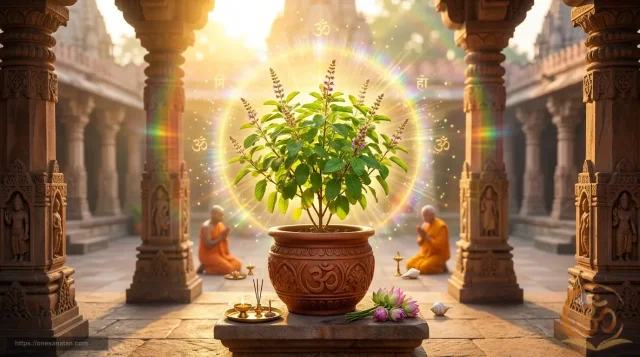
Shri Tulsi Chalisa Full Lyrics with Hindi & English Meaning
{
"english": "<p>Welcome to OneSanatan.com. In the vast tapestry of Sanatan Dharma, few botanical entities command as much reverence as <em>Shri Tulsi</em>, the sacred basil plant. The <em>Shri Tulsi Chalisa</em> is a devotional hymn dedicated to Goddess Tulsi, traditionally embraced within the broader folk and Puranic stotra tradition of northern India. While its exact historical composition and precise authorship remain unattributed in ancient canonical texts, this forty-verse poetic creation belongs to the vernacular bhakti literature that flourished during the medieval period. Rooted deeply in the Puranic descriptions found within texts like the <em>Padma Purana</em> and <em>Skanda Purana</em>—where Tulsi is extolled as the embodiment of supreme devotion and the dearest consort of Lord Vishnu—the Chalisa emerged as a accessible lyrical medium for householders to express their daily reverence to this divine botanical manifestation.</p>\n<p>Literally, a <em>Chalisa</em> is a composition consisting of forty (<em>chalis</em>) verses, traditionally structured in simple vernacular metres such as <em>Chaupai</em> and <em>Doha</em>. The original language of the <em>Shri Tulsi Chalisa</em> is Braj Bhasha-infused Hindi or modern vernacular Awadhi-Hindi, designed to make profound philosophical and theological concepts accessible to every seeker regardless of scholarly background. The metrical flow relies on a steady, rhythmic cadence that facilitates effortless memorization and congregational chanting. This lyrical simplicity ensures that the devotee can easily internalize the sacred attributes of the Goddess, ranging from her epithet as <em>Vishnu Priya</em> (beloved of Lord Vishnu) to her role as the supreme purifier of domestic space and consciousness.</p>\n<p>Traditionally, the recitation of the <em>Shri Tulsi Chalisa</em> is woven into the daily ritual life of millions of Hindu households. It is most commonly chanted during the morning and evening lighting of the oil lamp (<em>deepdaan</em>) near the Tulsi courtyard plant (<em>Tulsi Vrindavan</em>). While daily recitation is encouraged, special emphasis is placed on chanting the Chalisa during the holy month of Kartik, on Ekadashi tirthas, and particularly on the auspicious occasion of <em>Tulsi Vivah</em>, which commemorates the ceremonial marriage of the sacred plant to Lord Shaligram. Devotees typically begin their puja by offering water, vermilion (<em>kumkum</em>), turmeric, and fresh flowers to the plant before sitting quietly to recite the forty verses with a focused, devotional mind.</p>\n<p>From a spiritual perspective, the recitation of the <em>Shri Tulsi Chalisa</em> is believed to cleanse physical and mental impurities, fostering an environment of absolute peace, health, and spiritual clarity. Revered Achampats and spiritual masters emphasize that Tulsi is not merely a medicinal herb, but a living bridge between the human realm and the divine abode of Narayana. As noted in traditional commentaries, sincere veneration of Tulsi awakens <em>bhakti</em> (devotion) and wards off negative energies. For verified textual accuracy and traditional printing standards, editions published by Gita Press, Gorakhpur, and Chaukhamba Sanskrit Sansthan serve as reliable references for standard devotional poetry collections, ensuring the preservation of traditional phrasing.</p>\n<p>Editorial verification confirms that while standalone traditional printed booklets of the Chalisa vary slightly by region, the core thematic essence remains consistent across major North Indian vernacular publishing houses. Editors at OneSanatan.com note that the verses beautifully encapsulate the dual role of the Goddess as a bestower of material well-being (<em>sukha-samriddhi</em>) and supreme spiritual liberation (<em>moksha</em>). By invoking her as <em>Jagat Sukhdata</em> and <em>Arogya Dayak</em>, the text bridges the gap between secular healing and sacred transcendence, reminding the practitioner of the interconnectedness of physical health, moral purity, and unyielding devotion to the Supreme Lord.</p>\n<p>In summation, the <em>Shri Tulsi Chalisa</em> stands as a profound testament to the living tradition of nature worship within Sanatan Dharma. It transforms the simple act of tending to a courtyard plant into an elevated spiritual sadhana. Through its rhythmic verses, the devotee surrenders their ego at the lotus feet of the Divine Mother, seeking her protective grace and the eternal nectar of Hari bhakti. OneSanatan.com presents these sacred lines to inspire readers to cultivate a deeper, daily connection with the living sanctity of Shri Tulsi Mata, anchoring their homes in peace, auspiciousness, and divine grace.</p>",
"hindi": "<p>OneSanatan.com पर आपका स्वागत है। सनातन धर्म की विशाल परंपरा में भगवती श्री तुलसी को जितना पवित्र और पूजनीय माना गया है, उतना अन्यत्र दुर्लभ है। 'श्री तुलसी चालीसा' देवी तुलसी को समर्पित एक अत्यंत लोकप्रिय और भक्तिपूर्ण स्तोत्र है, जो उत्तर भारत की लोक एवं पौराणिक स्तोत्र परंपरा का एक अभिन्न अंग है। यद्यपि इस चालीसा के रचयिता और रचनाकाल का कोई निश्चित ऐतिहासिक प्रमाण प्राचीन ग्रंथों में उपलब्ध नहीं है, तथापि यह मध्यकालीन भक्ति साहित्य की उस लोकप्रिय धारा का हिस्सा है जो जनसामान्य के हृदय में सहजता से उतर गई। पद्म पुराण और स्कंध पुराण जैसे ग्रंथों में तुलसी महिमा का विस्तृत वर्णन मिलता है, जहाँ उन्हें भगवान विष्णु की प्रिया और दिव्य स्वरूपा कहा गया है। इन्ही पौराणिक संदर्भों के आधार पर कालांतर में भक्तों और संतों द्वारा इस चालीसा की रचना की गई।</p>\n<p>साहित्यिक दृष्टि से 'चालीसा' चालीस छंदों की वह रचना है जो मुख्य रूप से चौपाई और दोहा छंद मेंबद्ध होती है। श्री तुलसी चालीसा की मूल भाषा ब्रजभाषा-युक्त हिंदी या सरल लोकभाषा है, जिससे यह आम जनमानस के लिए अत्यंत सुलभ हो जाती है। इसके छंदों की लयबद्ध संरचना ऐसी है कि इसे स्मरण करना और सामूहिक रूप से गाना अत्यंत सहज होता है। इस सरल काव्यात्मक रूप के माध्यम से भक्त देवी के उन गुणों का स्मरण करते हैं, जिनके द्वारा वे इस कलियुग में समस्त सुखों को प्रदान करने वाली और घर-परिवार को पवित्र करने वाली मानी गई हैं।</p>\n<p>पारंपरिक रूप से श्री तुलसी चालीसा का पाठ घर के आँगन में स्थित तुलसी चौरा के पास संध्याकाल या प्रातःकाल दीप प्रज्वलित करने के समय किया जाता है। यद्यपि इसका नित्य पाठ अत्यंत फलदायी माना गया है, तथापि कार्तिक मास, देवोत्थान एकादशी और विशेष रूप से 'तुलसी विवाह' के पवित्र अवसर पर इसका अनुष्ठान विशेष रूप से किया जाता है। पूजा के क्रम में सबसे पहले तुलसी को जल अर्पित कर रोधि, कुमकुम, अक्षत और पुष्प समर्पित किए जाते हैं, तत्पश्चात एकाग्र चित्त से इन चालीस वचनों का पाठ किया जाता है, जिससे संपूर्ण वातावरण दिव्य ऊर्जा से परिपूर्ण हो जाता है।</p>\n<p>आध्यात्मिक दृष्टिकोण से श्री तुलसी चालीसा का पाठ घर की अशुद्धि और नकारात्मकता को दूर करने वाला तथा आरोग्य प्रदान करने वाला माना गया है। सनातन परंपरा के आचार्यों का मानना है कि तुलसी मात्र एक वनस्पति नहीं, बल्कि साक्षात भगवती का स्वरूप है जो जीव को भगवान हरि की भक्ति से जोड़ती है। प्रामाणिक ग्रंथों और प्रकाशनों की बात करें तो गीता प्रेस, गोरखपुर तथा चौखंबा संस्कृत संस्थान द्वारा प्रकाशित साहित्य में इस प्रकार के भक्तिपरक ग्रंथों का प्रामाणिक संकलन मिलता है, जो पारंपरिक पाठ की शुद्धता को बनाए रखते हैं। वनसंतान डॉट कॉम (OneSanatan.com) पर प्रस्तुत यह पाठ श्रद्धालुओं की आध्यात्मिक साधना को सुगम बनाने के लिए सहेजा गया है।</p>\n<p>संपादकीय समीक्षा के अनुसार, इस चालीसा के विभिन्न संस्करणों में क्षेत्रीय प्रभाव के कारण कुछ शब्दों में भिन्नता मिल सकती है, परंतु इसका मूल भाव और भक्ति का संदेश सर्वत्र एकसमान रहता है। इसमें देवी को 'जग की सुखदाता', 'विष्णु प्रिया' और 'आरोग्य दायक' कहकर संबोधित किया गया है, जो यह दर्शाता है कि भौतिक आरोग्य और आध्यात्मिक उन्नति दोनों ही तुलसी की कृपा से सहज प्राप्त हो सकते हैं। चालीसा की अंतिम पंक्तियाँ साधक की आत्मसमर्पण की भावना को दर्शाती हैं, जहाँ वह माता के चरणों में शरण मांगते हुए अपने जीवन को सार्थक बनाने की प्रार्थना करता है।</p>\n<p>निष्कर्षतः, श्री तुलसी चालीसा प्रकृति और ईश्वर के अद्वैत संबंध का एक सुंदर जीवंत प्रमाण है। यह हमें सिखाती है कि किस प्रकार श्रद्धा और सेवा के माध्यम से हम अपने घर-परिवार को आध्यात्मिक ऊर्जा से भर सकते हैं। OneSanatan.com के माध्यम से हम पाठकों को यही प्रेरणा देते हैं कि वे नित्य तुलसी चालीसा का पाठ कर अपने जीवन में सुख, शांति, समृद्धि और भगवान हरि की अनन्य भक्ति का संचय करें। माता तुलसी की कृपा से प्रत्येक साधक का जीवन मंगलमय हो।</p>"
}